1. Introduction
This paper introduces Optical Proof of Work (oPoW), a novel consensus algorithm designed to address the critical scalability, environmental, and centralization flaws inherent in traditional electricity-intensive Proof-of-Work (PoW) systems like Bitcoin's SHA256. The authors argue that while PoW's security relies on imposing a verifiable economic cost, there is no fundamental reason for this cost to be predominantly operational (electricity) rather than capital (hardware). oPoW leverages advancements in silicon photonics to create a mining process where the primary cost is hardware (CAPEX), drastically reducing energy consumption (OPEX).
2. The Problem with Traditional PoW
Bitcoin's security model, based on Hashcash, has proven robust but comes with significant drawbacks:
- Energy Intensity & Environmental Impact: Mining consumes electricity comparable to medium-sized countries, raising sustainability concerns.
- Geographic Centralization: Miners congregate in regions with cheap electricity (e.g., certain parts of China, historically), creating single points of failure and vulnerability to regulatory crackdowns or partition attacks.
- Economic Volatility Link: Network hashrate is highly sensitive to Bitcoin's price. A price drop can make mining unprofitable, leading to a rapid exodus of miners and a potential decrease in network security.
3. Optical Proof of Work (oPoW) Concept
oPoW proposes a shift from electronic to photonic computation for mining. It is designed to be compatible with existing Hashcash-like protocols but optimized for photonic co-processors.
3.1 Core Algorithm & Hardware
The algorithm requires miners to find a nonce such that the hash of the block header meets a specific target. The key innovation is that the hash function is computed using a silicon photonic integrated circuit (PIC). These circuits use light (photons) instead of electrons to perform computations, offering orders-of-magnitude improvements in energy efficiency and speed for specific, parallelizable tasks like the matrix multiplications inherent in many cryptographic functions.
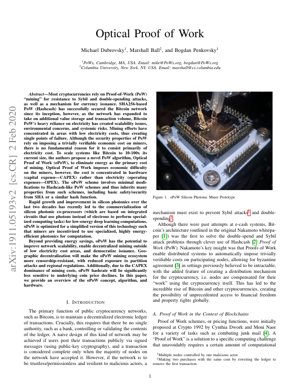
The paper references a prototype (Figure 1) but notes the technology is based on commercially emerging silicon photonic co-processors initially targeted at AI/ML workloads.
3.2 Economic Model Shift
oPoW flips the mining cost structure:
- Traditional PoW: Cost ~ 90% OPEX (Electricity), 10% CAPEX (ASICs).
- oPoW: Cost ~ 10% OPEX (Electricity), 90% CAPEX (Photonic Hardware).
This has profound implications: mining becomes feasible anywhere with a standard power outlet, breaking the geographic stranglehold of cheap electricity. Security becomes more stable as hashrate is tied to durable hardware assets rather than volatile electricity prices.
4. Technical Details & Mathematical Foundation
While the paper does not disclose the full proprietary algorithm, it outlines that oPoW is based on a modified hash function $H'(x)$ that is computationally equivalent to a standard hash (e.g., SHA256) for verification but is specifically engineered to be most efficiently computed on a photonic processor.
The "work" in oPoW likely involves solving a problem that maps elegantly to operations performed by a Mach-Zehnder Interferometer (MZI) mesh on a PIC, a common architecture for photonic matrix processors. The computation can be framed as finding a solution vector $\vec{s}$ such that:
$\vec{o} = M \cdot \vec{s} + \vec{n}$
Where $M$ is a large, fixed matrix implemented by the photonic circuit, $\vec{s}$ is the input (derived from the block data and nonce), and $\vec{o}$ must satisfy a target condition (e.g., leading zeros in its hash). The noise vector $\vec{n}$ may represent inherent physical properties. The search for the correct $\vec{s}$ is brute-force, but each evaluation is extremely fast and low-power on the dedicated hardware.
5. Prototype & Experimental Results
The paper presents Figure 1: oPoW Silicon Photonic Miner Prototype. The description indicates a lab-scale setup featuring:
- A silicon photonic chip mounted on a carrier board.
- Optical fiber inputs/outputs for laser light.
- Supporting electronic control circuitry (FPGA/CPU) for managing the photonic chip and interfacing with the blockchain network.
Key Claimed Results:
- Energy Efficiency: The photonic processor achieves a theoretical energy-per-hash improvement of 10-100x over state-of-the-art electronic ASICs, as photonic components generate minimal heat and light propagation is inherently low-power.
- Speed: Photonic computation operates at the speed of light within the chip, offering latency advantages for each computational cycle.
- Verification Parity: A standard CPU can verify an oPoW solution as quickly as a standard Hashcash solution, maintaining network decentralization.
Note: The paper is a pre-print (arXiv:1911.05193v2) and specific, peer-reviewed benchmark data against commercial ASICs is not provided.
6. Analyst's Perspective: Core Insight & Critique
Core Insight: Dubrovsky et al. aren't just tweaking Bitcoin; they're attempting to surgically replace its economic engine. The real innovation isn't the photonics—it's the deliberate re-architecting of mining's cost basis from a consumable (energy) to a capital asset (hardware). This fundamentally alters the security and game theory of PoW, potentially making it more geographically resilient and less environmentally toxic. It's a direct response to the ESG (Environmental, Social, and Governance) reckoning facing crypto.
Logical Flow: The argument is compelling: 1) PoW security needs cost, 2) Current cost is energy, causing problems X, Y, Z, 3) Can we make the cost hardware instead? 4) Yes, with photonics. 5) This solves X, Y, Z. The logic is clean, but the entire edifice rests on two assumptions: that photonic hardware can be made both superior for this task and resistant to remonetization via even more advanced electronics (like ASICs did to GPUs), and that the capital cost itself is sufficiently "wasteful" to deter bad actors—a premise challenged by the sunk-cost fallacy and the potential for hardware resale markets.
Strengths & Flaws:
- Strengths: Addresses the #1 PR problem for Bitcoin (energy). Promotes decentralization. Leverages a real, advancing hardware trend (silicon photonics for AI). The CAPEX-dominant model could indeed stabilize security budgets.
- Critical Flaws: The paper is light on public, auditable cryptographic details, smelling of "security through obscurity." It risks creating a new, different centralization—around access to cutting-edge photonic fab plants (e.g., Intel, GlobalFoundries). The transition problem is monumental: convincing the existing Bitcoin ecosystem, with its billions in ASIC investments, to adopt oPoW is a political and economic nightmare akin to a hard fork on steroids. As noted by researchers like Biryukov and Khovratovich, any asymmetry between mining and verification efficiency is a potential vulnerability.
Actionable Insights:
- For Investors: Watch companies bridging photonics and computing (e.g., Ayar Labs, Lightmatter). oPoW may not dethrone Bitcoin, but it could be the genesis kernel for a new, "green" blockchain that appeals to institutional capital with ESG mandates.
- For Developers: Treat this as a blueprint for next-gen consensus design. The core idea—designing PoW for a specific, advantageous hardware paradigm—is powerful. Explore hybrid models or its application in smaller, purpose-driven networks first.
- For the Industry: This is a credible shot across the bow. The Bitcoin community can no longer dismiss energy concerns as FUD. Even if oPoW fails, it pressures ASIC manufacturers to radically improve efficiency and pushes other projects (like Ethereum did with Proof-of-Stake) to seek alternatives. The conversation has permanently shifted.
7. Analysis Framework: A Non-Code Case Study
Case: Evaluating a New PoW Algorithm for a Sustainability-Focused Blockchain.
Framework Application:
- Problem Definition: Our blockchain must have a physical cost for security but needs a >70% reduction in energy use vs. SHA256 to meet sustainability pledges.
- Solution Screening (oPoW Evaluation):
- Security: Does it impose a verifiable, asymmetric cost? Yes (specialized hardware).
- Efficiency: Does it meet the energy reduction target? Claimed yes, requires independent audit.
- Decentralization: Is hardware likely to be broadly accessible? Risk: High initial cost and specialized fabrication could limit early access.
- Adoption Path: Can we launch with it? Possible as a new chain, impossible for Bitcoin migration.
- Decision: oPoW is a high-potential, high-risk candidate. Proceed with a funded research consortium to build an open-source prototype and publish rigorous benchmarks against ASICs. In parallel, design a tokenomics model that incentivizes distributed hardware manufacturing.
8. Future Applications & Development Roadmap
Short-term (1-3 years):
- Development of fully open-source oPoW algorithm specifications and reference photonic chip designs.
- Launch of a small-scale testnet (similar to Bitcoin's early days) to validate security and decentralization assumptions in practice.
- Targeted use in private/consortium blockchains for ESG-reporting or green finance, where energy efficiency is a direct regulatory or marketing advantage.
Medium-term (3-7 years):
- If testnets succeed, launch of a major new public cryptocurrency with oPoW at its core, positioned as the "green Bitcoin."
- Potential integration as a secondary, energy-saving layer for existing blockchains (e.g., a merge-mined sidechain).
- Advancements in photonic chip manufacturing reducing costs, improving accessibility.
Long-term & Convergence:
- oPoW hardware could dual-purpose as accelerators for AI inference, creating a hybrid economic model for miners.
- The principles could inspire "Proof of Useful Work" where the photonic computation also solves verifiable, real-world scientific problems (e.g., protein folding simulations).
- Potential standardization of photonic hashing functions by bodies like NIST, similar to post-quantum cryptography standards.
9. References
- Nakamoto, S. (2008). Bitcoin: A Peer-to-Peer Electronic Cash System.
- Back, A. (2002). Hashcash - A Denial of Service Counter-Measure.
- Dwork, C., & Naor, M. (1992). Pricing via Processing or Combatting Junk Mail. CRYPTO '92.
- Biryukov, A., & Khovratovich, D. (2014). Equihash: Asymmetric Proof-of-Work Based on the Generalized Birthday Problem. IACR Cryptology ePrint Archive.
- Shen, Y., et al. (2017). Deep learning with coherent nanophotonic circuits. Nature Photonics. (External source on photonic AI processors)
- Buterin, V. (2022). Merge Complete. Ethereum Foundation Blog. (External source on major consensus change feasibility)