1. Introduction
This paper introduces Optical Proof of Work (oPoW), a novel consensus algorithm designed to address the critical scalability, environmental, and centralization flaws inherent in traditional electricity-intensive Proof-of-Work (PoW) systems like Bitcoin's SHA256. The authors argue that while PoW's security relies on imposing a verifiable economic cost, there is no fundamental reason for this cost to be predominantly operational (electricity) rather than capital (hardware). oPoW leverages advancements in silicon photonics To create a mining process where the primary cost is hardware (CAPEX), drastically reducing energy consumption (OPEX).
2. The Problem with Traditional PoW
Bitcoin's security model, based on Hashcash, has proven robust but comes with significant drawbacks:
- Energy Intensity & Environmental Impact: Mining consumes electricity comparable to medium-sized countries, raising sustainability concerns.
- Geographic Centralization: Miners congregate in regions with cheap electricity (e.g., certain parts of China, historically), creating single points of failure and vulnerability to regulatory crackdowns or partition attacks.
- Economic Volatility Link: Network hashrate is highly sensitive to Bitcoin's price. A price drop can make mining unprofitable, leading to a rapid exodus of miners and a potential decrease in network security.
3. Optical Proof of Work (oPoW) Concept
oPoW proposes a shift from electronic to photonic computation for mining. It is designed to be compatible with existing Hashcash-like protocols but optimized for photonic co-processors.
3.1 Core Algorithm & Hardware
The algorithm requires miners to find a nonce such that the hash of the block header meets a specific target. The key innovation is that the hash function is computed using a silicon photonic integrated circuit (PIC). These circuits use light (photons) instead of electrons to perform computations, offering orders-of-magnitude improvements in energy efficiency and speed for specific, parallelizable tasks like the matrix multiplications inherent in many cryptographic functions.
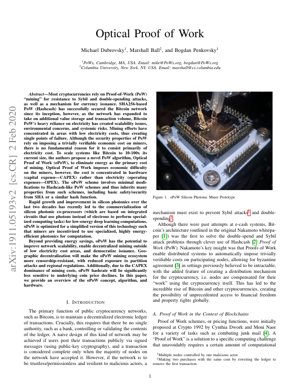
The paper references a prototype (Figure 1) but notes the technology is based on commercially emerging silicon photonic co-processors initially targeted at AI/ML workloads.
3.2 Economic Model Shift
oPoW flips the mining cost structure:
- Traditional PoW: Cost ~ 90% OPEX (Electricity), 10% CAPEX (ASICs).
- oPoW: Cost ~ 10% OPEX (Electricity), 90% CAPEX (Photonic Hardware).
This has profound implications: mining becomes feasible anywhere with a standard power outlet, breaking the geographic stranglehold of cheap electricity. Security becomes more stable as hashrate is tied to durable hardware assets rather than volatile electricity prices.
4. Technical Details & Mathematical Foundation
While the paper does not disclose the full proprietary algorithm, it outlines that oPoW is based on a modified hash function $H'(x)$ that is computationally equivalent to a standard hash (e.g., SHA256) for verification but is specifically engineered to be most efficiently computed on a photonic processor.
The "work" in oPoW likely involves solving a problem that maps elegantly to operations performed by a Mach-Zehnder Interferometer (MZI) mesh akan PIC, tsarin gama-gari na masu sarrafa matrix na photonic. Ana iya tsara lissafin kamar nemo madaidaicin vector $\vec{s}$ kamar haka:
$\vec{o} = M \cdot \vec{s} + \vec{n}$
Inda $M$ babban matrix ne mai tsayayye wanda aka aiwatar da shi ta hanyar da'irar photonic, $\vec{s}$ shine shigar (wanda aka samo daga bayanan block da nonce), kuma $\vec{o}$ dole ne ya gamsar da yanayin manufa (misali, gubar sifili a cikin hash ɗinsa). Vector hayaniyar $\vec{n}$ na iya wakiltar kaddarorin zahiri na asali. Neman daidai $\vec{s}$ shine ƙarfi-ƙarfi, amma kowane kimantawa yana da sauri sosai da ƙarancin wutar lantarki akan kayan aikin da aka keɓe.
5. Prototype & Experimental Results
The paper presents Figure 1: oPoW Silicon Photonic Miner Prototype. The description indicates a lab-scale setup featuring:
- A silicon photonic chip mounted on a carrier board.
- Optical fiber inputs/outputs for laser light.
- Supporting electronic control circuitry (FPGA/CPU) for managing the photonic chip and interfacing with the blockchain network.
Key Claimed Results:
- Energy Efficiency: The photonic processor achieves a theoretical energy-per-hash improvement of 10-100x over state-of-the-art electronic ASICs, as photonic components generate minimal heat and light propagation is inherently low-power.
- Speed: Photonic computation operates at the speed of light within the chip, offering latency advantages for each computational cycle.
- Verification Parity: A standard CPU can verify an oPoW solution as quickly as a standard Hashcash solution, maintaining network decentralization.
Note: The paper is a pre-print (arXiv:1911.05193v2) and specific, peer-reviewed benchmark data against commercial ASICs is not provided.
6. Analyst's Perspective: Core Insight & Critique
Core Insight: Dubrovsky et al. e kereke te Bitcoin; e gbalagbala lati ṣe atunṣe ẹrọ iṣowo rẹ ni ọna ti o ṣe pataki. Iṣẹ tuntun gidi kii ṣe fotoniiki—o jẹ iṣẹdidarapọ̀ mọ́nàmọ́nà ti ipilẹ iye-owo iwakusa lati ohun elo ti a nlo (agbara) si ohun-ini owo-ori (ẹrọ). Eyi yipada ipilẹṣẹ ati ero ere ti PoW, o le ṣe ki o di alagbara si ori ilẹ ati kii ṣe aleebu si ayika. O jẹ idahun taara si iṣiro ESG (Ayika, Awujọ, ati Iṣakoso) ti o dojuko kripto.
Logical Flow: Aṣayan naa ni iṣeduro: 1) Aabo PoW nilo iye-owo, 2) Iye-owo lọwọlọwọ jẹ agbara, n fa awọn iṣoro X, Y, Z, 3) Ṣe a le ṣe iye-owo jẹ ẹrọ dipo? 4) Bẹẹni, pẹlu fotoniiki. 5) Eyi yoo yanju X, Y, Z. Ero naa dara, ṣugbọn gbogbo ile naa duro lori ero meji: pe ẹrọ fotoniiki le ṣe jẹ ti o dara julọ fun iṣẹ yii ati pe o le koju atunṣe owo-ori nipasẹ ẹrọ oniṣẹ ti o ga si (bi ASICs ṣe ṣe si GPUs), ati pe iye-owo owo-ori funra rẹ jẹ "ofofo" to lati dènà awọn olutọ-ẹṣẹ—ero kan ti a nira si nipasẹ aṣiṣe iye-owo ti a fi sile ati anfani fun awọn ọja tita ẹrọ pada.
Strengths & Flaws:
- Strengths: Addresses the #1 PR problem for Bitcoin (energy). Promotes decentralization. Leverages a real, advancing hardware trend (silicon photonics for AI). The CAPEX-dominant model could indeed stabilize security budgets.
- Critical Flaws: The paper is light on public, auditable cryptographic details, smelling of "security through obscurity." It risks creating a new, different centralization—around access to cutting-edge photonic fab plants (e.g., Intel, GlobalFoundries). The transition problem is monumental: convincing the existing Bitcoin ecosystem, with its billions in ASIC investments, to adopt oPoW is a political and economic nightmare akin to a hard fork on steroids. As noted by researchers like Biryukov and Khovratovich, any asymmetry between mining and verification efficiency is a potential vulnerability.
Actionable Insights:
- For Investors: Watch companies bridging photonics and computing (e.g., Ayar Labs, Lightmatter). oPoW may not dethrone Bitcoin, but it could be the genesis kernel for a new, "green" blockchain that appeals to institutional capital with ESG mandates.
- For Developers: Iri nọọ̀n bí àwòrán ìlànà fún àgbékalẹ̀ ìjọ̀rò ìtẹ̀síwájú. Èrò àkọ́kọ́—ṣíṣe PoW fún àpẹẹrẹ ẹ̀rọ aláǹfààní kan pàtó—ló lágbára. Ṣàwárí àwọn àpẹẹrẹ àdàpọ̀ tàbí lìlò rẹ̀ nínú àwọn nẹ́tíwọọ̀kì kékeré, tí a múná dò sí, ní akọ́kọ́.
- Fún Ilé-iṣẹ́: Ìyẹn jẹ́ ìdánilẹ́kọ̀ọ́ tó ní ìtẹ́lọ́rùn. Àwùjọ Bitcoin kò lè tún sá àwọn ìdààmú agbára gẹ́gẹ́ bí FUD mọ́. Bó tilẹ̀ jẹ́ wípé oPoW kò ṣe aṣeyọrí, ó fún àwọn olùṣèdá ASIC lẹ́rù láti mú iṣẹ́ṣe dára púpọ̀, ó sì tún lé e mi àwọn iṣẹ́ ìṣàkóso mìíràn (bí Ethereum ṣe ṣe pẹ̀lú Proof-of-Stake) láti wá àwọn ònà ìyàtọ̀. Ìjíròrò náà ti yí padà lásán.
7. Analysis Framework: A Non-Code Case Study
Case: Evaluating a New PoW Algorithm for a Sustainability-Focused Blockchain.
Framework Application:
- Problem Definition: Our blockchain must have a physical cost for security but needs a >70% reduction in energy use vs. SHA256 to meet sustainability pledges.
- Solution Screening (oPoW Evaluation):
- Security: Does it impose a verifiable, asymmetric cost? Yes (specialized hardware).
- Efficiency: Does it meet the energy reduction target? Claimed yes, requires independent audit.
- Decentralization: Is hardware likely to be broadly accessible? Risk: High initial cost and specialized fabrication could limit early access.
- Adoption Path: Can we launch with it? Possible as a new chain, impossible for Bitcoin migration.
- Decision: oPoW is a high-potential, high-risk candidate. Proceed with a funded research consortium to build an open-source prototype and publish rigorous benchmarks against ASICs. In parallel, design a tokenomics model that incentivizes distributed hardware manufacturing.
8. Future Applications & Development Roadmap
Short-term (1-3 years):
- Development of fully open-source oPoW algorithm specifications and reference photonic chip designs.
- Launch of a small-scale testnet (similar to Bitcoin's early days) to validate security and decentralization assumptions in practice.
- Targeted use in private/consortium blockchains for ESG-reporting or green finance, where energy efficiency is a direct regulatory or marketing advantage.
Medium-term (3-7 years):
- Idan gwaje-gwajen cibiyoyin sadarwa suka yi nasara, za a ƙaddamar da sabon babban kuɗin sirri na jama'a tare da oPoW a tsakiyarsa, wanda aka tsara shi a matsayin "Bitcoin mai kore."
- Yuwuwar haɗawa a matsayin sakandare, matakin ceton makamashi don ingantattun blockchains (misali, gefen haɗin ma'adinai).
- Ci gaba a cikin masana'antar kera kwakwalwan kwamfuta ta haske yana rage farashi, inganta samun dama.
Long-term & Convergence:
- Vifaa vya oPoW vinaweza kutumika kwa madhumuni mawili kama vihimili vya AI inference, na kuunda muundo mseto wa kiuchumi kwa wachimbaji.
- Kanuni hizo zinaweza kuchochea "Uthibitisho wa Kazi Yenye Manufaa" ambapo hesabu ya fotoni pia inatatua matatizo ya kisayansi yanayoweza kuthibitishwa, ya ulimwengu halisi (k.m., uigaji wa kunyoosha protini).
- Uwezekano wa kuanzishwa kwa viwango vya vitendakazi vya fotoni vya kufupisha na taasisi kama NIST, sawa na viwango vya usimbaji fiche baada ya kwanta.
9. References
- Nakamoto, S. (2008). Bitcoin: A Peer-to-Peer Electronic Cash System.
- Back, A. (2002). Hashcash - A Denial of Service Counter-Measure.
- Dwork, C., & Naor, M. (1992). Pricing via Processing or Combatting Junk Mail. CRYPTO '92.
- Biryukov, A., & Khovratovich, D. (2014). Equihash: Asymmetric Proof-of-Work Based on the Generalized Birthday Problem. IACR Cryptology ePrint Archive.
- Shen, Y., et al. (2017). Deep learning with coherent nanophotonic circuits. Nature Photonics. (External source on photonic AI processors)
- Buterin, V. (2022). Merge Complete. Ethereum Foundation Blog. (External source on major consensus change feasibility)