1. Introduction & Core Problem
Bitcoin's Nakamoto consensus, secured by sequential proof-of-work (PoW), revolutionized decentralized trust but introduced probabilistic finality. The security of accepting a transaction is asymptotic—it becomes "secure enough" only after waiting for multiple block confirmations. This uncertainty is the root cause of double-spending attacks and selfish mining strategies. While recent work by Li et al. (AFT '21) provided concrete security bounds for Bitcoin's model, a fundamental question remained: Can non-sequential PoW designs offer superior, quantifiable security?
This paper by Keller and Böhme directly challenges the sequential paradigm. It proposes a new family of state replication protocols based on parallel proof-of-work, where each block is secured by $k$ independent cryptographic puzzles solved concurrently, rather than one chain of dependent puzzles. The core contribution is a bottom-up design from a robust agreement sub-protocol, enabling the derivation of concrete, computable upper bounds for the protocol's failure probability under adversarial conditions in synchronous networks.
Core Proposition
Parallel PoW can enable state update finality after a single block confirmation with a bounded, acceptably low failure probability, effectively removing double-spending risk for many applications without long waiting times.
2. Technical Framework & Protocol Design
The protocol design represents a principled departure from heuristic parallel PoW proposals (e.g., Bobtail).
2.1. Sequential vs. Parallel PoW: Architectural Shift
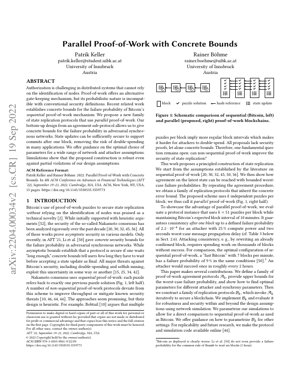
The fundamental shift is from a linear chain to a directed acyclic graph (DAG) of puzzle dependencies at the block level.
- Sequential (Bitcoin): Blockn → PoWn → Hashn → Blockn+1. Security relies on the cumulative work of the longest chain.
- Parallel (Proposed): Blockn → {PoW1, PoW2, ..., PoWk}. A block is valid only upon collecting $k$ independent puzzle solutions. This creates a "wider" and statistically more regular security barrier.
2.2. The Agreement Sub-Protocol Ak
The heart of the construction is protocol $A_k$, which achieves agreement on a single state update. It operates in a synchronous network model with a known maximum message delay $\Delta$. Honest nodes control a fraction $\beta$ of the total computational power, while a Byzantine adversary controls $\alpha = 1 - \beta$.
$A_k$ yana ci gaba a zagaye. A kowane zagaye, nodes suna ƙoƙarin warware wasanin gwada ilimi $k$. An cimma yarjejeniya kan ƙimar da aka tsara (misali, block) lokacin da wani mai gaskiya ya lura da isassun hanyoyin warware wasanin gwada ilimi ($\geq$ bakin kofa $t$) don wannan ƙimar a cikin takamaiman taga lokaci da aka samo daga $\Delta$ da wahalar wasan gwada ilimi. Ma'auni $k$ da $t$ sune mahimman levers don daidaita tsaro da jinkiri.
2.3. Deriving Concrete Failure Probability Bounds
The paper's key analytical achievement is bounding the probability that $A_k$ fails (i.e., honest nodes disagree on the agreed value). Failure can occur if the adversary, through a burst of computational power or network delay manipulation, can create a competing set of puzzle solutions that causes a split view.
The bound is expressed as a function of: $\alpha$ (adversarial power), $k$ (puzzles per block), $t$ (agreement threshold), $\Delta$ (network delay), and the puzzle difficulty parameter. The analysis uses probabilistic reasoning about Poisson processes for puzzle solving and worst-case scheduling of adversarial actions. By repeating $A_k$, the bound extends to the entire state replication protocol.
3. Experimental Results & Performance
The theoretical framework is validated through parameter optimization and simulation.
3.1. Security Guarantees: One-Block Finality
The paper showcases a protocol instance with $k=51$ puzzles/block, maintaining Bitcoin's 10-minute expected block interval. Under conservative assumptions (25% attacker power, $\Delta=2s$), it guarantees consistency after one block with a failure probability of $2.2 \times 10^{-4}$. This means an attacker trying to reverse a confirmed block would need to expend work equivalent to thousands of blocks for a single success. This enables practical finality for payments after a single confirmation.
2.2e-4
Failure Probability (1-block)
25%
Adversarial Power
51
Puzzles per Block (k)
3.2. Comparative Analysis vs. "Fast Bitcoin"
The contrast with sequential PoW is stark. The "optimal" sequential configuration for fast finality—a "fast Bitcoin" with a 7-block/minute rate—has a 9% failure probability Under the same conditions (25% attacker, 2s delay). An attacker would succeed roughly every 2 hours, making single-confirmation payments highly risky. Parallel PoW reduces this failure rate by over two orders of magnitude.
Chart Description (Implicit): A dual-axis chart would show: 1) Failure Probability (log scale) vs. Adversarial Power $\alpha$, comparing the parallel ($k=51$) and fast sequential curves. The parallel curve remains orders of magnitude lower. 2) Time-to-Finality (blocks), showing parallel protocol at 1 block and sequential requiring 6+ blocks for comparable security.
3.3. Robustness to Model Violations
Simulations demonstrate that the protocol remains robust even when the theoretical synchronous network model is partially violated (e.g., occasional longer delays). The statistical nature of requiring multiple ($k$) independent solutions provides inherent resilience, as an adversary cannot easily disrupt all solution propagations simultaneously.
4. Analyst's Perspective: Core Insight & Logical Flow
Core Insight: The paper successfully reframes the blockchain security problem from a chain-based race to a statistical threshold consensus problem. The real breakthrough isn't just parallelism—it's the formal recognition that requiring a quorum of independent computational proofs ($k$ puzzles) within a bounded time window allows for direct probabilistic modeling of worst-case attacks. This is akin to moving from judging a race by a single runner's lead to requiring a majority of independent referees to confirm the result simultaneously. The work of Li et al. on concrete bounds for Bitcoin was the necessary precursor, proving such analysis was possible. Keller and Böhme then asked the right next question: if we can bound a chain, can we design a better primitive that yields a tighter bound? This mirrors the evolution in other fields, like the shift from single discriminators in early GANs to multi-scale discriminators in models like Pix2Pix or CycleGAN for improved stability and fidelity.
Logical Flow: The argument is elegantly constructed: 1) Identify the Limitation: Sequential PoW's probabilistic finality is inherent and leads to exploitable uncertainty. 2) Propose a New Primitive: Replace the single-puzzle chain link with a multi-puzzle block. 3) Build from First Principles: Design a one-shot agreement protocol ($A_k$) for this new primitive. 4) Quantify Rigorously: Derive the concrete failure probability of $A_k$ under a standard adversarial model. 5) Scale and Compare: Show how repeating $A_k$ creates a full ledger and demonstrate overwhelming superiority over the optimized sequential baseline. The logic is watertight and avoids the hand-waving that plagued earlier parallel proposals.
5. Strengths, Flaws & Actionable Insights
Strengths:
- Rigorous Foundation: Provides the first formal, concretely bounded security proof for a parallel PoW protocol, elevating it from heuristic to cryptographic primitive.
- Practical Impact: The $2.2 \times 10^{-4}$ failure probability for one-block finality is a game-changer for payment processors and exchanges, potentially eliminating the 1-hour wait for Bitcoin "confirmation."
- Parameter Tunability: The framework offers clear guidance for choosing $k$ and difficulty based on network conditions ($\Delta$) and threat model ($\alpha$), enabling tailored deployments.
Flaws & Open Questions:
- Synchronous Network Assumption: The reliance on a known $\Delta$ is a significant limitation. Real-world peer-to-peer networks are partially synchronous at best. While simulations show robustness, the formal guarantee weakens.
- Communication Overhead: Propagating $k$ solutions per block increases bandwidth overhead by a factor of ~$k$ compared to sequential PoW. For $k=51$, this is substantial and could impact decentralization.
- Unclear Incentive Compatibility: The paper focuses on security. The incentive structure for miners in this parallel model—how rewards are split for partial solutions—is not deeply explored and could introduce new attack vectors like solution withholding.
Actionable Insights:
- For Researchers: This is the new baseline for analyzing non-sequential PoW. Future work must tackle the partial synchrony model and formalize incentive design. Exploring hybrid models (small $k$) for legacy chains could be a fruitful interim step.
- For Practitioners (Layer 2, Sidechains): This protocol is a prime candidate for securing sidechains or rollups where the parent chain (e.g., Ethereum) can act as a synchronization beacon, helping bound $\Delta$. Its fast finality is perfect for high-throughput financial sidechains.
- For the Industry: Stop viewing parallel PoW as just a throughput hack. This paper provides the mathematical toolkit to engineer it for security-first applications. Regulatory discussions around blockchain finality should incorporate these concrete probability bounds.
6. Technical Deep Dive: Mathematical Formalism
The core of the concrete bound derivation hinges on modeling the puzzle-solving process as a Poisson process with rate $\lambda = 1/D$, where $D$ is the expected time to solve one puzzle. Honest nodes have a combined rate $\lambda_h = \beta \cdot k / D$, and the adversary has rate $\lambda_a = \alpha \cdot k / D$ for solving puzzles for a specific competing block.
The failure event for protocol $A_k$ is analyzed over a critical time window of length $L$, which is a function of $\Delta$ and the protocol's waiting periods. The probability that the adversary can generate at least $t$ solutions in this window while the honest network generates fewer than $t$ solutions for the honest block is bounded using tail inequalities for Poisson distributions (e.g., Chernoff bounds).
The resulting upper bound for the failure probability $\epsilon$ takes a form reminiscent of:
7. Analysis Framework: A Non-Code Case Study
Scenario: A digital asset exchange wants to decide whether to credit deposits after 1 confirmation on a new parallel PoW blockchain versus requiring 6 confirmations on a traditional Bitcoin-style chain.
Framework Application:
- Define Risk Tolerance: The exchange sets a maximum acceptable failure probability for a deposit reversal at $10^{-5}$ per transaction.
- Gather Parameters:
- Parallel Chain: Advertised parameters: $k=51$, $\alpha_{max}=0.25$, $\Delta_{max}=2s$. From the paper's model, query the bound for $\epsilon_{1-block}$.
- Sequential Chain: Use the model from Li et al. (2021) to calculate $\epsilon_{6-conf}$ for Bitcoin with 10-min blocks, given estimated $\alpha$ and $\Delta$.
- Quantitative Comparison:
- Parallel $\epsilon_{1-block} \approx 2.2 \times 10^{-4}$. This is above the $10^{-5}$ tolerance.
- To meet tolerance, the exchange could either: a) Wait for a 2nd block on the parallel chain (reducing $\epsilon$ exponentially), or b) Use the sequential chain with 6 confs, where $\epsilon_{6-conf}$ might be ~$10^{-8}$, but with a 1-hour delay.
- Business Decision: Exchange na iya zaɓi manufar haɗe-haɗe: Don sarkar layi daya, ba da ƙarancin lamuni bayan toshe 1 ($\epsilon=2.2e-4$) da manyan adadi bayan toshe 2 ($\epsilon\ll10^{-5}$), cimma duka sauri ga masu amfani da tsaro ga kasuwanci. Wannan yana nuna yadda takamaiman iyaka ke ba da bayanai kai tsaye ga manufar aiki.
8. Future Applications & Research Directions
Aikace-aikace Nan take:
- High-Value Payment Channels: The fast, bounded-finality property is ideal for the settlement layer of payment channel networks, where rapid and irrevocable settlement is crucial.
- Regulated Asset Tokens: For security tokens or CBDCs, regulators require clear finality guarantees. This protocol's concrete probabilities can be audited and integrated into compliance frameworks, unlike asymptotic guarantees.
- Cross-Chain Bridges: A parallel PoW sidechain could act as a trust-minimized bridge between major blockchains, with its security properties precisely verifiable by both sides.
Research Directions:
- Beyond Synchrony: The most critical step is to adapt the model to partial synchrony or the "sleepy model" of consensus, which better reflects real-world conditions.
- Incentive Mechanism Design: Formal analysis of Nash equilibria in the parallel mining game. How to reward partial solution submissions to prevent centralization?
- Hybrid Consensus: Combining parallel PoW for fast leader election or committee selection with efficient BFT consensus (e.g., HotStuff, Tendermint) for ordering within a block. This could yield optimal trade-offs.
- Hardware Implications: Exploring how parallel puzzle solving interacts with modern mining hardware (ASICs). Does it favor different architectures or reduce the advantage of large mining pools?
9. References
- Keller, P., & Böhme, R. (2022). Parallel Proof-of-Work with Concrete Bounds. In Proceedings of the 4th ACM Conference on Advances in Financial Technologies (AFT '22).
- Nakamoto, S. (2008). Bitcoin: A Peer-to-Peer Electronic Cash System.
- Li, J., et al. (2021). Bitcoin Security with Bounded Adversaries under Network Delay. In Proceedings of AFT '21.
- Garay, J., Kiayias, A., & Leonardos, N. (2015). The Bitcoin Backbone Protocol: Analysis and Applications. In EUROCRYPT.
- Pass, R., Seeman, L., & Shelat, A. (2017). Analysis of the Blockchain Protocol in Asynchronous Networks. In EUROCRYPT.
- Bobtail: A Blockchain with Much Smaller Tail Latency. (2019). S. Bano, et al. NDSS.
- Isola, P., et al. (2017). Image-to-Image Translation with Conditional Adversarial Networks. CVPR. (Cited as an example of principled multi-component design evolution in ML).
- Buterin, V. (2014). On Slow and Fast Money. Ethereum Blog. (Context on finality vs. latency trade-offs).